And now it is solstice, that bittersweet reckoning of the gardener. I just came in from tying up my tomatoes. Everything out there is reaching for the sky. Up, up, up they go drawing nourishment from below and above. One of my runner beans actually made it to the top of the trellis today. Now what?
Well you can look for a hint in the garlic bed. Some of my soft necks are starting to bend over and I watch them closely for readiness for harvest. 4-6 dead leaves and it is time.
I am on my porch facing east taking in the solstice sunset from the obverse angle ... watching the shadows lengthen across the hayfield. I am aware that this time of planting and preparation is now at its zenith. Often when I am in the yard in say late April I will say to myself ... this is what the sun will be like in late August. In August there is a bountiful harvest ... even harvest fatigue ... but not so in the light of April. In that very same light, that very same exposure to the sun's angle and duration the garden is only barren possibilities. I comfort myself in those April moments that the days are still getting longer and the best is yet to come.
But today begins the undoing. It is a bittersweet moment.
Monday, June 21, 2010

Turning up the heat
 Well I think I have solved the case of the unwanted visitor in my compost pile. I simply gave it a good turn, added some activator, watered it well, and the next thing I knew it was too uncomfortable for the visitor to forage. If I can keep it humming at 130 degrees + all summer, I should achieve two goals ... good compost and no visitors.
Saturday, June 19, 2010
Water and watch
 click to enlarge
Right now is an odd time ... odd in a nice way. The frenzy of preparation is over. The asparagus has been put to bed.
 And the peas are a good week away from production.
  Each day the garden is getting taller, and all I have to do is water and watch.
The over wintered artichokes are putting up fruit.
 Meanwhile, I have made beds outside the garden for the ones I started from seed.
  And I have transplanted one into a 15 inch pot with plans to overwinter in the basement.
 My other experiment involves growing a pair of French melon plants in a container far removed from the garden in the hope that their pollination will be uncontaminated and that I can use the seeds for next year. Now if I can just remember to water it.
Sunday, June 13, 2010
Need advice
 I need some advice about how to coax a critter out of my compost. Three years ago I bought a really sturdy black compost bin for my kitchen scraps complete with critter guard. For two years it was a fortress. Then one spring I returned to find a hole eaten into it and a completely rotated, aerated compost pile. The critter did not return until the following December, about the time I stop using the bin, so I decided on a live and let live attitude for this winter rental.
 Well, this spring he/she has not abandoned the bin upon my return, but is still in residence. Not in residence exactly, but a nocturnal visitor let's say. I have read ideas about how to discourage visits ... keep the pile wet ... plant mint near the bin ... I even tried sprinkling a quart of cayenne juice on top of the scraps before covering.
Obviously I cannot plant mint overnight, but I did stuff some in the hole as a temporary solution.
 I am afraid that the critter of which I speak rhymes with cat, and I do not want to encourage visits from same. Anyone have any solutions, short of the obvious poisonous ones?
Thursday, June 10, 2010
From infancy to puberty in 6 short days
I had to be away for about 6 days. In that short time, the garden went from infancy to puberty. The tomatoes have weathered their transplant and are well established.  With the exception of the Killarney Red and the Chesnok Red, all of the garlic scapes have been harvested, and the plants are busy below ground now bulbing out.
  Perhaps most exciting was seeing the runner beans taking hold of the bean trellis. I can almost hear the lead leaf shouting over his shoulder ...
 "Hang on down there ... you're in for the ride of your life!"
 With the exception of the Killarney Red and the Chesnok Red, all of the garlic scapes have been harvested, and the plants are busy below ground now bulbing out.
  Perhaps most exciting was seeing the runner beans taking hold of the bean trellis. I can almost hear the lead leaf shouting over his shoulder ...
 "Hang on down there ... you're in for the ride of your life!"
Sunday, June 06, 2010

Wednesday, June 02, 2010
Garlic from head to toe
 Here is a healthy garlic plant. It sports 10 leaves with a scape on top. (that little brown leaf on the left counts) When 4 - 6 of these leaves turn brown, it is time to harvest. Each leaf is a wrapper for the bulb underground and so you want 4-6 green leaves to ensure a tight wrap on the bulb after curing.
I look at my garlic everyday this time of year marveling at the differences among the scapes. Here is a classic rocambole curly scape.
 The purple stripes like Pskem dip their heads like shy swans atop their plant
 So I have harvested at least half of the scapes now and am storing them in the fridge. They make great stir fry and are wonderful additions to anything on the grill. You want to pick them once they have curled, but BEFORE they begin to straighten. It will send more energy to the bulb as these wonderful plants turn from scallions to full bulbs in less than a month.
All planted out
 Well with a few exceptions, I can say that the garden is "planted out." It has been a struggle wrestling with weeds and grasses, but with some help from Hunter we have tamed the wild portions of the garden and brought order where there was chaos.
 For this 6 feet of pathway, Hunter took out
 this wheelbarrow full of grass roots.
My plan this year was to focus on the two fruits I love the most ... tomatoes and a charentais melon grown in Cavaillon known as tranche de miel. In my decade of gardening there has never been a moment in which I have said "too many tomatoes this summer." I've done it with cukes and summer squash ... even with shallots, but never with tomatoes and certainly not with these amazing melons. So right now there are 39 tomato plants and 8 melon plants in the garden.

The tomato varieties are:
Big Zac =12
Italian Sweet = 8
Better Boy = 8
Belgian Giant =2
Boxcar Willie = 4
Sungold = 2
Costolutto Genovese =1
Hillbilly = 1
Brandywine = 1.
To make room for these I decided not to plant potatoes this year ... neither sweet nor regular. The store does a better job than I do. However, it happens to be my husband's favorite crop, so he is running a potato bin at the back of the garden with the last of the Red Norlands SBS had on the shelf. I also sacrificed Winter Squash ... I still have four butternut squash from last season in the basement. However, yesterday I did plant a few Waltham Butternut seeds at the east end of the garlic bed, and some Baby Pam Pumpkins at the west end. Maybe there will be a successful overlapping of the bed this year.
I still have some artichoke plants that will need a bed outside the garden, but I can work on that later. Also, I read yesterday that one CAN container garden artichokes and bring them inside for the winter. So I am off to find a few 16 " clay pots.
But it is pretty much tomatoes and melons as far as the eye can see. I plan to container grow two melons away from the garden, in the hopes that the seeds from those melons will not be tainted by cross pollination.
I have been having a cutworm problem ... attacks to newly sprouted green beans and some of my trasured melons, so I tried a little trick with hosta stems proposed by Daphne.
 Elsewhere in the news:
  There was successful fruiting in the apple "orchard" this spring despite those surprise late frosts. Because of our exposure to cedar apple rust, I chose resistant varieties like Freedom and Jonafree. However there was one "experiment" in the orchard ... an Arkansas Black ... and it is sporting its first fruit this year.
Wednesday, May 26, 2010
Moving ahead
 This warm weather is inspiring. Most of the beds are amended and ready for planting. Here is a wheelbarrow full of composted lamb manure (decorated with a buttercup). Each barrow full is delightfully rich and teeming with wriggling earthworms. Life as it should be.
 Two weekends ago I went to Brimfield, MA for their spring antiques extravaganza. It was there that I found this old shutter for the garden. I will plant nasturtiums at its feet for climbing.
 Things continue be about two weeks ahead of schedule out there as evidenced by the early appearance of garlic scapes. These are definitely a mid-June PHE-nom in these parts.
Saturday, May 15, 2010
Artichoke update
 This is one of my over-wintered artichokes. It looks like it usually looks in late JULY !!! Seeing these is a source of daily satisfaction this spring. I have been keeping them well watered and each week have given them a good dose of manure tea. With this much of a head start on the season, I want to milk these plants for all they are worth.
The shady back bed
 I have a bed at the back of the garden that each year gets more and more shade. Last year it grew potatoes. This year I decided to do a combination of shallots and Brussels sprouts, Swiss Chard, Cippolini onions, carrots, parsnips and radishes. I find I get the best results with carrots if I sift the soil first and place it back in a trench ... not very wide nor terribly deep, but enough to give the little guys a fighting chance of pushing their way in to the ground.
  I also have found that one of my best spring planting tools is the reused dish soap container. Poke a hole in the ground, squirt in some water. Nest in the shallot, or the bean or the seedling. Very handy indeed.
Sunday, May 09, 2010
Asparagus Soup Revisted
 The asparagus rolls in at the rate of nearly a pound a day. During high season I keep a plastic bag in the fridge where I store the snapped off ends and use them to make soup.
 I found a new soup recipe in the spring issue of Edible Vineyard. Edible Communities, Inc. sponsors the publication of these local magazines on a quarterly basis. Do you have one in your area? Any good recipes to share? If you do have such a magazine in your area, make a point of supporting the local advertisers who help to make the publication possible. And here is the recipe which I tweaked a little bit.
Asparagus Soup with No Dairy Garlic Cream
1 lb asparagus stems
2 TBS EVO
1 cup yellow onion small dice
½ cup rolled oats
5 cups Vegetable stock
Garlic “Cream”
1 medium head separated into cloves and peeled
2 TBS EVO
1 cup water
4 sprigs thyme
Freshly ground black pepper
2 tsp fresh lemon juice and chopped parsley for garnish
During asparagus season I save the snapped off ends of all the asparagus I prepare and I use these ends to make soup. For this recipe use one pound of those ends which you have slit down the middle. In addition select maybe 6-8 thin spears and slice 4 one inch slices off each of them to add to the finished soup. Cook these tips for 4 minutes in boiling salted water and set aside.
Warm the oil in a soup pot and add the onion and sauté for 8-10 minutes until they soften. Add the oats, the slit stems and the stock and bring to a boil. Lower the heat and simmer partially covered for about 30 minutes.
Once this has cooled put in the blender, puree, and then run the mixture through a sieve using the bottom of a soup ladle to push through the juice. Discard the fibrous remains. Return to a saucepan.
In a smaller saucepan prepare the garlic “cream” by combining the garlic, oil water and thyme. Simmer uncovered until the garlic is soft, about 20 minutes. Discard the thyme sprigs and transfer to a blender. Puree and add back to the soup. Add the reserved cooked tips and salt and pepper to taste. Just before serving, freshen with lemon juice and a sprinkling of chopped parsley.
adapted from Hara Dretaki Edible Vineyard Spring 2010
Raw Milk
I invite you to read this Salute to Raw Milk on Jan Buhrman's blog. Jan is organizing a rally tomorrow morning 8 AM on Boston Common (complete with a cow) to protest proposed changes in the language of regulations concerning the sale of raw milk in Massachusetts.
I grew up on raw milk. My mother, a physician, believed that it would help us develop a better immune system. When I retired after a 30 year teaching career, I had 2 years of unused sick leave, a testament to the effectiveness of the raw milk of my childhood.
I guess I am a little cranky these days about a world in which people who want to feed their families from sustainable farms bump up against a highly tuned regulatory mechanism working for the benefit of the big milk producers, while Congress wrings its hands about how to (or even IF to) regulate a financial industry that took us to the brink of disaster and then took OUR money to cover their bad choices.
I am not a tea-paryter ... but I could become a milk-partyer.
I grew up on raw milk. My mother, a physician, believed that it would help us develop a better immune system. When I retired after a 30 year teaching career, I had 2 years of unused sick leave, a testament to the effectiveness of the raw milk of my childhood.
I guess I am a little cranky these days about a world in which people who want to feed their families from sustainable farms bump up against a highly tuned regulatory mechanism working for the benefit of the big milk producers, while Congress wrings its hands about how to (or even IF to) regulate a financial industry that took us to the brink of disaster and then took OUR money to cover their bad choices.
I am not a tea-paryter ... but I could become a milk-partyer.

Friday, May 07, 2010
Let the games begin !
 I arrived on a breezy, sunny afternoon to find some nice gifts in the garden. I was able to harvest about 4 pounds of asparagus and set to work cooking it on the grill for dinner. I have been eating asparagus from the farmer's market for a few weeks now, but still it does not have the flavor of fresh from the garden.
  The next morning I found some random greens ... spinach and sorrel ... and I set it aside in the fridge.
 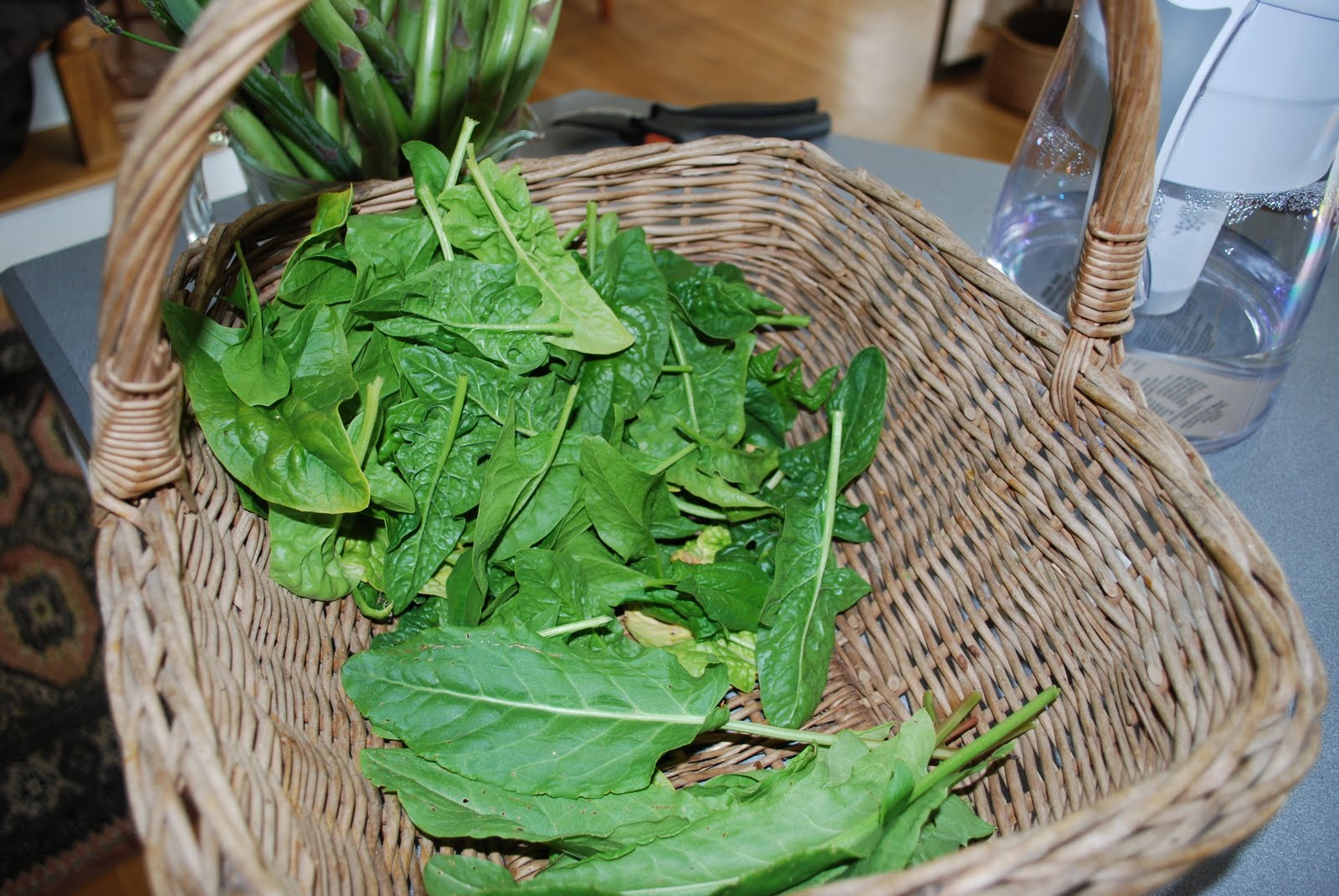 So the harvest has begun. Now I must set to work doing all the things that other gardeners have been doing since March ... pulling weeds ... cleaning beds ... working compost ...
I must say I feel that the season is at least two weeks ahead this year. The landscape looks like Memorial Day not May Day. I even got my first whiff of autumn olive this morning. Two extra weeks of growing season is fine with me.
Tuesday, April 20, 2010
Over Wintering Artichokes
 Steve asked how I managed the successful over wintering of these Green Globe artichokes. Actually I thought readers were a little bored with this story which has been going on in here for nearly 5 years. Please begin by reading these past posts .
I used wall-o-waters the past two seasons. I did not succeed in 2008/2009. But this winter I did succeed. I suspect the success this time is linked to two factors: the way I prepared the plants and the kind of winter we had ... mostly the latter. This year I cut what remained of the plants to 6 inches above ground and covered them in grass clippings before putting on the wall-o-waters. But mostly I think it was the snow cover and the lack of extreme cold that led to success.
Our local garden columnist, Lynne Irons, also reported having successfully over wintered her artichokes this year. She uses different materials, but also gives lots of credit to what was overall a mild winter.
"Speaking of enjoyment — several of my globe artichokes made it through the winter. I had covered them with a double layer of Reemay and enclosed the bed with bales of hay. Keep in mind, however, we did have a mild winter. I do not believe we dipped into the single digits at all. Nobody believes me when I say such things because it was rainy, snowy and gloomy a great deal of the time, but all in all, the temperatures held steady."
One other thought to successful over wintering in northern climates is the variety of the artichoke. Imperial Star has not done well for me. I have experimented with and Northern Star and Emerald but have not had success over wintering them. The ones I had success with were Green Globe Improved from Reimer Seeds.
One other thought to successful over wintering in northern climates is the variety of the artichoke. Imperial Star has not done well for me. I have experimented with and Northern Star and Emerald but have not had success over wintering them. The ones I had success with were Green Globe Improved from Reimer Seeds.
Sunday, April 18, 2010
Halleluia
I made a quick dash north this weekend to feed and spray the apple trees and put some seedlings under grow lights until I return again in early May. It is a lousy weekend weather wise, but I was greeted with a great success. It may not look like much to you, but what you see in this photograph is something I have been waiting for for at least four maybe five seasons ... a successfully over-wintered artichoke. I am hoping these nice strong plants will produce early and often this year.
On a hunch I dropped by a stand of Japanese knotweed I know in a friend's backyard. I hit it at JUST the right time and was rewarded with a bountiful harvest. It is an invasive brought to the States by none other than the man who brought us Central Park, the landscape architect Frederick Law Olmstead. It tastes a lot like rhubarb and can be used in its place for many recipes. I will cut it up and freeze it and boil it down into a compote a little later in the season. The great thing about htis invasive is that it is a great source for RESVERATROL I also made time to harvest some parsnips for a spring dug parsnip chowder.
 It may not look like much to you, but what you see in this photograph is something I have been waiting for for at least four maybe five seasons ... a successfully over-wintered artichoke. I am hoping these nice strong plants will produce early and often this year.
On a hunch I dropped by a stand of Japanese knotweed I know in a friend's backyard. I hit it at JUST the right time and was rewarded with a bountiful harvest. It is an invasive brought to the States by none other than the man who brought us Central Park, the landscape architect Frederick Law Olmstead. It tastes a lot like rhubarb and can be used in its place for many recipes. I will cut it up and freeze it and boil it down into a compote a little later in the season. The great thing about htis invasive is that it is a great source for RESVERATROL
 I also made time to harvest some parsnips for a spring dug parsnip chowder.
Friday, April 02, 2010
The Easter Parade

Let's hear it for the trees. This is their season. In my backyard the tulip magnolia is giving off an intoxicating fragrance. If only we had a scratch and sniff capability here.
 Then, of course, there is the princess of all the trees ... the cherry blossoms. I arrived a little before sunrise, but I was not alone. Here was a bride and her photographer setting up a sunrise photo shoot.
 The air was still enough to provide a crisp reflection in the tidal basin
 Then there is the classic shot with the Monument in the distance
 and, of course the broad sweep with reflection
 and the early sun on blossom and wood
 While Washington is most associated with cherry trees, I think the real stateliness of the city is in its find stand of American elms. These were planted by Governor Shepherd in the years after the Civil War. Why these trees escaped Dutch elm disease is a mystery to me. Anyone with information, please comment. So I wanted to give this elm tree its due.
  These dogs attracted lots of photographic attention.
  But already the cherry blossoms are falling like snowflakes
 but this crab apple is not far behind ready to take its place in the Easter Parade of Trees
Subscribe to:
Posts (Atom)